
Artificial Intelligence Revolution Java for beginners SSLC BIOLOGY MARCH 2025 SSLC SOCIAL SCIENCE-1-MARCH 2025 Super Solid-അതികരാവസ്ഥ The modern world is changing very fast, and at the forefront of this change is a revolutionary technology called Artificial Intelligence (AI). Today, the impact of AI can be seen everywhere in our environment, from smartphones and virtual assistants to educational methods. In such a situation, we need to consider how much AI is influencing the lives of young people. image courtesy-Pinterest.com Artificial intelligence offers numerous opportunities for young people, particularly in the fields of learning and research. Several online platforms assist students in learning subjects, completing homework, and conducting research. Additionally, AI is utilized as a teaching aid in classrooms, allowing teachers to provide more personalized attention to students. AI also benefits young people in the areas of creativity and innovation. For instance, it is u...
Model view controller(MVC)
The Hierarchy of Swing Classes
Model view controller(MVC)
Swing mainly follows the Model view controller(MVC) architecture. Using the Model view controller, we can make changes in one component without impacting or touching other components. It is also known as loosely coupled architecture.- The Model-View-Controller is a well-known software architectural pattern ideal for implementing user interfaces on computers by dividing an application into three interconnected parts.
- Swing uses the Model-View-Controller Architecture(MVC) as the fundamental design behind each of its components.
- Essentially, MVC breaks GUI components into three elements. Each of these elements plays a crucial role in how the component behaves.
- The main goal of MVC is to separate internal representations of an application from the ways information is presented to the user.
- Initially, MVC was designed for desktop GUI applications but it’s quickly become an extremely popular pattern for web applications too.
MVC pattern has three components
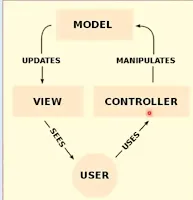
Model →That manages data, logic and rules of the application
View →That is used to present data to the user
Controller →That accepts input from the user and converts it to commands for the Model or View.
MVC Pattern You can see the interaction between these three components in the following figure.
- The Model-View-Controller is a well-known software architectural pattern ideal for implementing user interfaces on computers by dividing an application into three interconnected parts.
- Swing uses the Model-View-Controller Architecture(MVC) as the fundamental design behind each of its components.
- Essentially, MVC breaks GUI components into three elements. Each of these elements plays a crucial role in how the component behaves.
- The main goal of MVC is to separate internal representations of an application from the ways information is presented to the user.
- Initially, MVC was designed for desktop GUI applications but it’s quickly become an extremely popular pattern for web applications too.
MVC pattern has three components
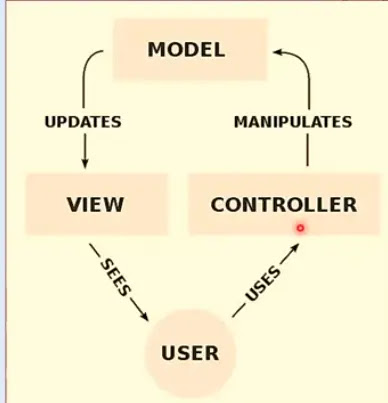
Model →That manages data, logic and rules of the application
View →That is used to present data to the user
Controller →That accepts input from the user and converts it to commands for the Model or View.
MVC Pattern You can see the interaction between these three components in the following figure.
The Hierarchy of swing classes
The root class in the hierarchy of the swing component is JComponent.It is an abstract class extended from the Container class of AWT. Since the Container class is extended from the Component class of AWT, JComponent extends the properties of both container and component classes.The entire set of classes in the hierarchy under JComponent are shown below.

The swing component is inherited from the javax.Swing.Jcomponent class, which is the root of the swing component hierarchy.
"Simple Java Program for Beginners" is a beginner-friendly guide to programming in Java. This program is designed to help new users learn the basics of Java programming language.
Comments
Post a Comment